
About JoyFund
Local Giving.
Organised for Health.
JoyFund mobilises community philanthropy to help low-income pregnant women overcome financial and last-mile barriers to essential maternal and newborn care-from pregnancy through the first 42 days after birth.

A Durable Impact Maternal & Newborn Health Initiative
Our Story
It started with a simple question.

It Started With One Woman and a Question of Trust.
JoyFund's story began before there was a platform, a website or even a name. In early 2021, our founder, Dr. Eric Kepeh Moh, came across the story of a pregnant woman named Jane who urgently needed support for her delivery and hospital care. A public appeal had already been made on her behalf, asking people to contribute whatever they could.
After verifying her situation, Eric contributed and shared the appeal with friends, family, mentors and professional networks. People responded. They wanted to help. But almost everyone asked some version of the same questions: Is the story real? Can we trust that the money will reach her? Those questions revealed something important.
The problem was not simply a lack of generosity. It was also a question of trust. Rather than transferring the contributions through an intermediary, Eric travelled to Douala, met Jane and personally delivered the money that had been mobilised. She received the support she needed, but the experience left behind a question that would eventually become much bigger than one medical appeal: How could we make it easier for people who want to help to do so through a mechanism they can trust? The generosity was already there. That experience reflected something deeply familiar about Cameroon.
Every day, people mobilise resources for one another through families, njangi groups, alumni associations, churches, professional networks, community organisations, diaspora networks and friendships. We contribute when someone is sick. We support one another in moments of hardship. And we come together to give during birthdays, weddings, graduations, promotions, anniversaries and other important moments in our lives.
The question, therefore, was not simply: How do we convince people to give?
“How do we organise the generosity that already exists?”
Over the years that followed, that question was explored through both practice and research into local philanthropy, community giving and locally led development. Then, with the creation of Durable Impact, came an opportunity to turn the idea into something practical: Could technology help organise our existing culture of solidarity into a more transparent, accountable and trusted mechanism for healthcare? That question became JoyFund.
JoyFund was developed as a home-grown digital platform connecting celebration, community generosity and healthcare support. The original model invited people to transform moments of joy-birthdays, weddings, graduations, promotions, anniversaries and other celebrations-into opportunities to support vulnerable people facing healthcare costs.
At its launch in June 2026, JoyFund sought to mobilise individual and community philanthropy for vulnerable mothers facing medical bills, elderly people unable to settle hospital costs, and individuals confronting critical medical emergencies. But beneath those different forms of support was one consistent ambition: To prove that local philanthropy can work in Cameroon. Not by replacing government. Not by replacing health facilities or development partners. And not by replacing the informal solidarity that already exists within our communities.
JoyFund was created to organise that solidarity-to make generosity more intentional, transparent, accountable and connected to real healthcare needs. And as we began that journey, listened more closely and examined the evidence, we discovered that there was another question we needed to confront: What if we could organise that generosity earlier-before financial hardship becomes a health crisis? That question marks the next chapter in the JoyFund story.

Why JoyFund Matters
For too many women, pregnancy still comes with financial barriers to essential care
Pregnancy and childbirth should not become more dangerous because a woman cannot afford care, reach a health facility, complete a referral or remain connected to essential maternal health services.
Yet maternal and newborn health indicators in Cameroon continue to show significant gaps in access and continuity of care. For low-income households, these challenges exist within a health system where families still carry a substantial share of healthcare costs directly.
The numbers tell an important story
The consequences extend to newborns
The challenge is not only whether maternal healthcare exists.
It is whether every woman can reach it, afford the costs she faces, and remain connected to appropriate care when she needs it.
Why We Evolved
From Responding to Medical Debt to Removing Barriers Earlier

JoyFund was originally designed to mobilise community philanthropy to help vulnerable people facing healthcare costs-including mothers with hospital bills, elderly people unable to settle their medical bills, and individuals experiencing critical medical emergencies.
That work responds to a real need.
But as we continued to learn, review evidence and better understand the realities of healthcare financing and maternal and newborn health in Cameroon, an important lesson became increasingly clear:
Waiting until someone is already in medical debt can mean intervening too late.
For a low-income pregnant woman, financial hardship may begin long before a hospital bill is issued. It may begin with an antenatal consultation she postpones because she cannot afford the associated costs. An essential test she cannot pay for. Transport she cannot afford to reach a health facility. Or a referral she cannot complete when higher-level care is needed.
By the time a family begins desperately raising money, financial and access barriers may already have delayed essential care. So we decided to intervene earlier.
JoyFund is moving from primarily responding to the financial consequences of healthcare exclusion towards helping prevent verified financial and last-mile barriers from disrupting essential maternal and newborn care.
Our primary focus is now low-income and vulnerable pregnant women and their newborns-from pregnancy through childbirth and the first 42 days after birth.
How JoyFund is Evolving
Then
- Responding to medical debt
- Emergency medical appeals
- One-off healthcare support
- Waiting until financial hardship becomes a crisis
Now
- Intervening earlier
- Organised health solidarity
- Continuity of maternal & newborn care
- Addressing verified barriers before they disrupt care
The principle has not changed. The point of intervention has.
JoyFund still believes in the power of local philanthropy. We are now seeking to organise that generosity earlier-before financial hardship becomes a health crisis.
Read Our Full Evolution StatementOur Philosophy - From Research to Practice
A philosophy grounded in evidence and lived experience
JoyFund did not begin with a platform. It began with research into local philanthropy, community giving and locally led development - and with the lived experience of individuals and families who wanted to help, but lacked a mechanism they could trust.
What the research and our own practice kept showing was that generosity was never the missing ingredient. Cameroonians already mobilise for one another through families, njangi groups, alumni associations, churches and diaspora networks. What was missing was a transparent way to organise that generosity into reliable healthcare support.
From that evidence and experience, a clear philosophy took shape: organise existing generosity - earlier - into a mechanism that is intentional, transparent, accountable and connected to real, verified healthcare needs.
Generosity is not the problem. Trust and organisation are.
That is why JoyFund intervenes before financial hardship becomes a health crisis - helping low-income and vulnerable pregnant women and their newborns stay connected to essential maternal and newborn care, from pregnancy through the first 42 days after birth.
Across Cameroon, this capacity is already visible. Families mobilise when relatives fall sick. Alumni associations invest in schools and communities. Churches and faith communities support people in difficulty. Njangi groups pool resources. Friends and professional networks respond to emergencies. Businesses contribute to social causes. Diaspora communities support families and community initiatives. During birthdays, weddings, graduations, anniversaries and other important moments, people give.
These practices reveal something fundamental: local philanthropy is not foreign to Cameroon. Solidarity already exists as part of the country's social fabric. JoyFund did not create that solidarity - its philosophy is to recognise it as an asset, organise it more effectively, and strengthen its capacity to contribute to health.
From Evidence to a Question
This philosophy is informed by research conducted by our founder, Dr. Eric Kepeh Moh, and Jimm Chick Fomunjong. Their study, Alumni Giving, #ShiftThePower and Locally-led Development in Cameroon, published by WACSI, examined locally organised giving and its contribution to community development in Cameroon.
The research documented how local giving already contributes to priorities including healthcare, education, water and sanitation, and wider community development - and highlighted resources that conventional development approaches can easily undervalue: trust, relationships, solidarity, social networks and local knowledge.
“What does #ShiftThePower look like when it moves from principle to practice?”
JoyFund is a practical exploration of that question.
Putting #ShiftThePower into Practice
The #ShiftThePower movement provides an important framework for this philosophy. Among its principles, three are particularly relevant to JoyFund.
Unlock Community Power
Communities possess agency and can help shape their own development. We recognise Cameroonians not simply as people waiting for healthcare assistance, but as individuals, families, networks and institutions capable of participating in solutions.
Build on Local Resources
We recognise, respect and strengthen the resources and assets that already exist locally - families, alumni networks, churches, businesses and diaspora communities all represent reservoirs that can contribute to collective action.
Look Beyond Money
Knowledge, trust, relationships and networks are resources that drive meaningful change. Money can finance care, but money alone cannot create a trusted system of community philanthropy.
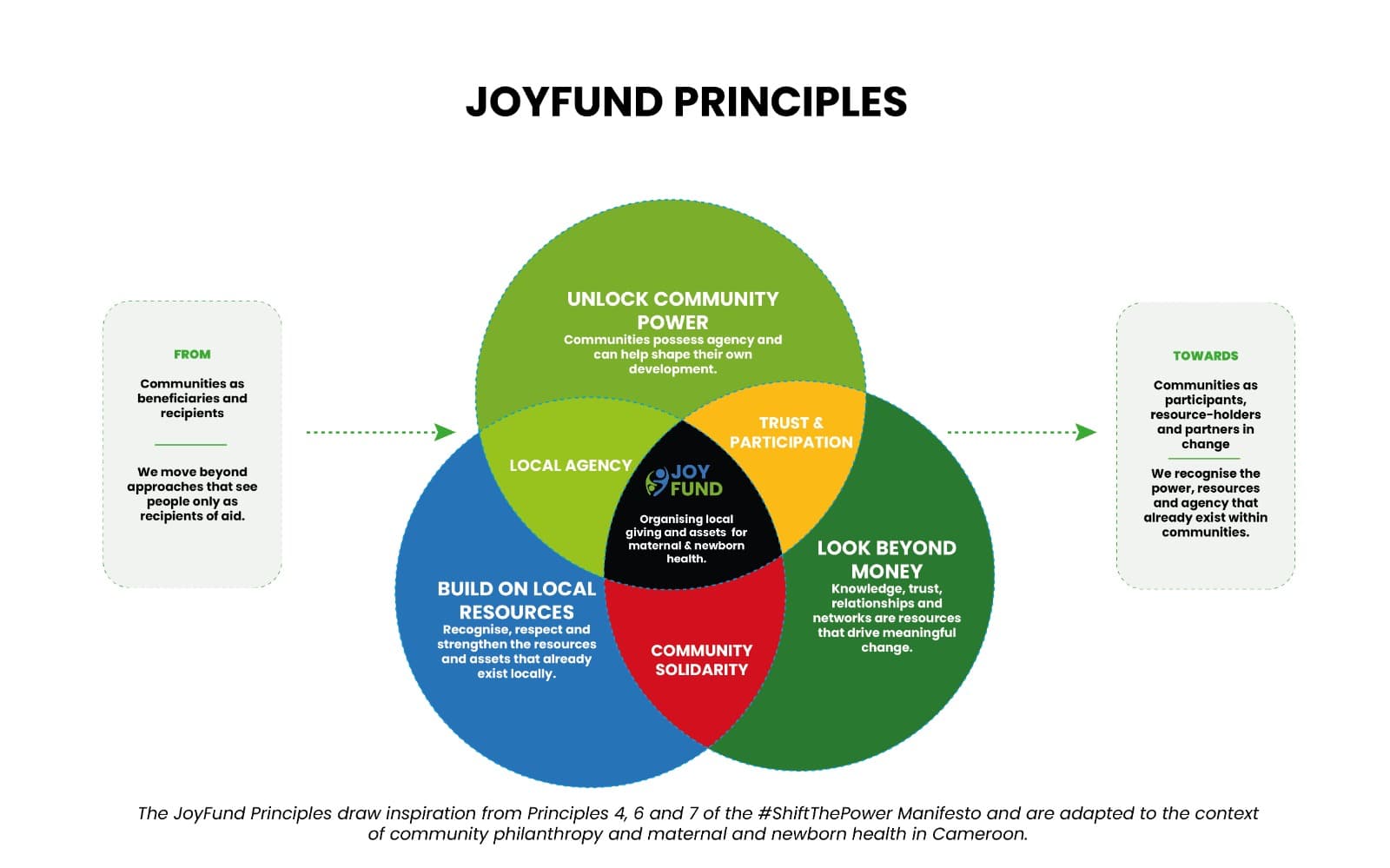
Not simply beneficiary, but participant.
Not simply recipient, but resource-holder.
Not simply a place of need, but a source of agency and possibility.
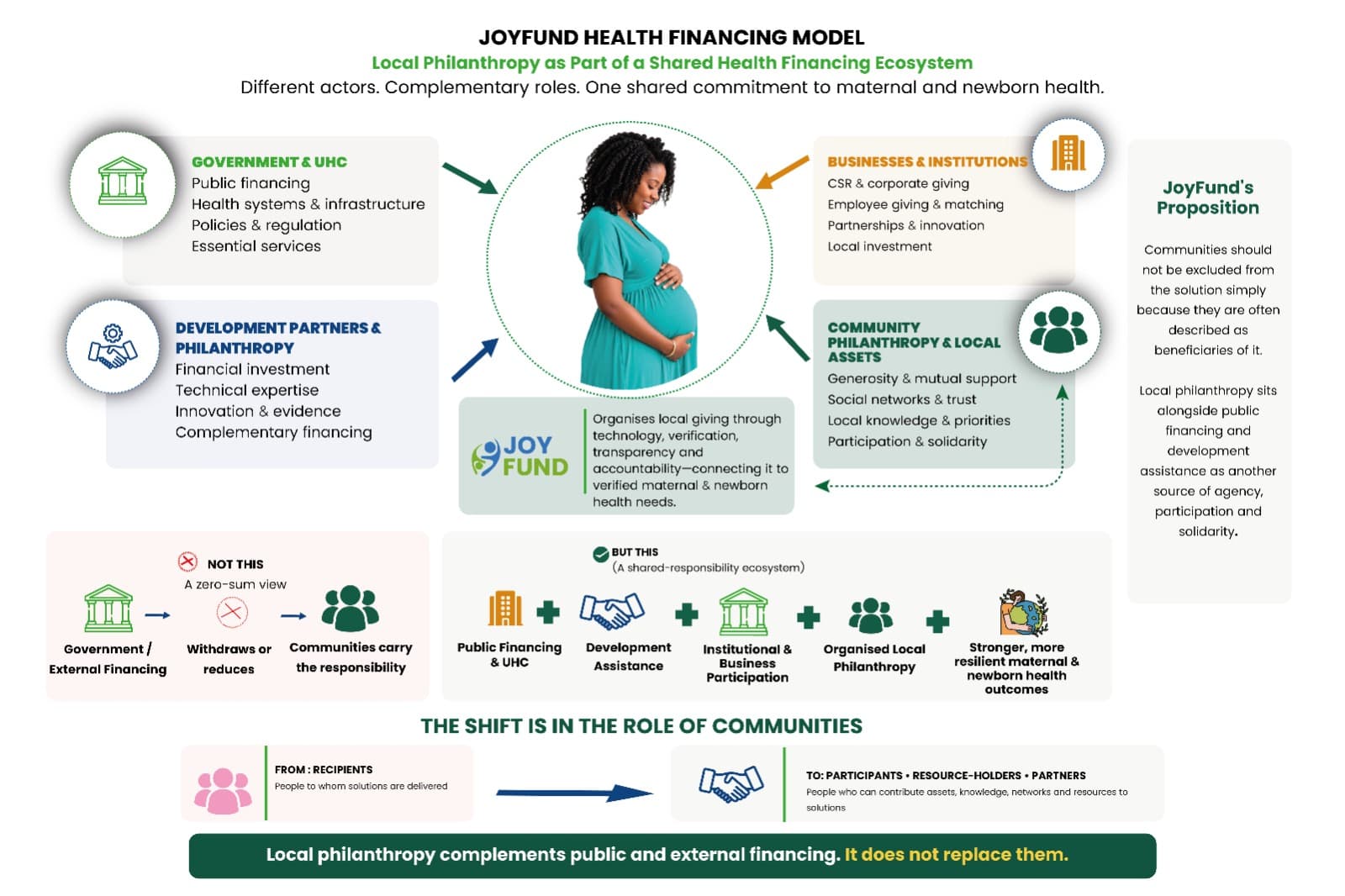
JoyFund translates this philosophy into a practical mechanism by combining local giving and community assets with technology, verification, transparency and accountability - turning dispersed acts of giving into more organised health solidarity.
Why Local Financing Matters Now
Maternal and newborn health in Cameroon depends on a combination of public, household and external resources. Uncertainty in external financing demonstrates the vulnerability of systems that depend too heavily on any single source of support.
A more resilient financing environment is one in which public financing, Universal Health Coverage, development assistance, institutional investment and organised local philanthropy perform complementary roles. Local philanthropy is neither a substitute for public responsibility nor an exit strategy for development partners - it is an additional source of agency, participation and locally rooted resources.
Shifting Power Does Not Mean Shifting Responsibility
Recognising community power must not become an argument for transferring responsibility for healthcare from institutions to vulnerable people. Government retains the responsibility to build equitable health systems and advance Universal Health Coverage. Health facilities retain responsibility for quality care. Development partners continue to play important financing and technical roles.
Community participation belongs alongside these responsibilities - not in place of them. The shift is not from government to communities. It is a shift in how communities are understood: from passive recipients to participants, resource-holders and partners.
Research Gave the Question. JoyFund Is Testing the Answer.
Can the trust, relationships, networks, generosity and resources already present within communities be organised into a transparent and accountable mechanism that helps remove barriers to essential maternal and newborn care? JoyFund is testing that proposition in practice.
The ambition extends beyond mobilising donations. It is to demonstrate what becomes possible when communities are recognised not only for what they need, but also for the power they already possess.
Our Approach
A practical model for community-powered maternal and newborn health
JoyFund combines celebration, community mobilisation, verification and direct provider payment into a single, transparent flow.
From Local Giving to Continuity of Care
JoyFund takes a different starting point to financing maternal and newborn health: mobilise resources before financial hardship becomes a health crisis.
Birthdays, weddings, baptisms, graduations and other milestones are moments when people already plan to spend, give and bring their networks together. JoyFund creates a voluntary pathway for individuals to dedicate a portion of those resources to maternal and newborn health - or invite family, friends and colleagues to give through their celebration.
Celebration-based giving is JoyFund's distinctive entry point, but it is not the only source of support. The approach also brings together corporate giving, diaspora giving, alumni giving and wider community philanthropy to build and continually replenish a pool of resources for maternal and newborn health.
Pooled Giving
Every JoyFund - birthday, wedding, graduation or promotion - feeds a shared fund, channelled through the People's Health Insurance Fund (PHIF).
Verified Beneficiaries
Low-income and vulnerable pregnant women are identified and screened by social workers, with needs verified through participating health facilities.
Direct-to-Provider Payment
Where care is supported, payments go directly to participating providers - never as cash to an individual.
Community Mobilisation
Celebrations, alumni giving and diaspora support turn everyday moments into reliable local philanthropy.
Transparency & Traceability
Every contribution, voucher and payment is logged publicly, from giving to care.
Intervening Earlier
Barriers - cost, transport, referrals - are addressed before they disrupt continuity of care.
A Continuous Cycle, Not a One-Off Appeal
The five stages work as a continuous, replenishing system - resources are mobilised and pre-funded, participants are assessed and verified, existing coverage is considered before financing a remaining access gap, approved support is connected to care and followed through, and results are accounted for to strengthen learning, transparency and trust.
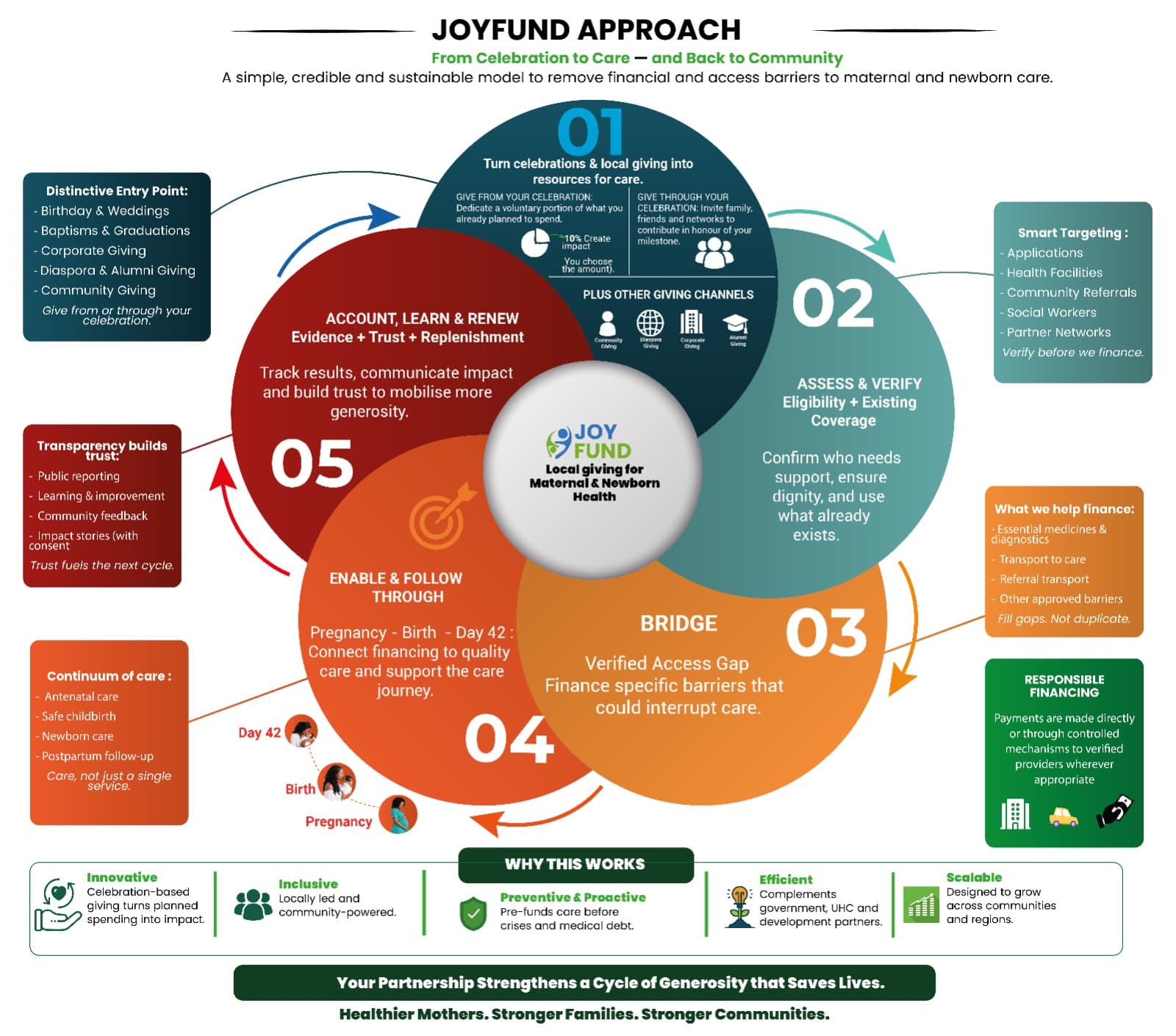
Generosity enables access. Access supports continuity. Continuity creates opportunity for better outcomes. Impact builds trust. Trust sustains generosity.
What Makes the Approach Different
JoyFund moves beyond the logic of waiting for a medical emergency and then launching an appeal. It seeks to mobilise earlier, verify before financing, complement what already exists, and support continuity from pregnancy through childbirth and the first 42 days after birth.
Local philanthropy does not replace government, Universal Health Coverage or development assistance - it becomes an organised, accountable part of a broader health-financing ecosystem.
Who We Are
A home-grown team building a national health fund
JoyFund is a maternal and newborn health initiative of Durable Impact, developed in Cameroon to organise local philanthropy into a more trusted, transparent and practical source of support for women and newborns facing financial and access barriers to essential care.
JoyFund brings together community philanthropy, technology, healthcare partnerships and accountable financing around a simple proposition: resources already exist within communities that can contribute meaningfully to better health when organised around verified needs and connected responsibly to care.
JoyFund is therefore more than a fundraising platform. It is an effort to build the infrastructure that connects generosity to care.
Built by Durable Impact
JoyFund was conceived and developed by Durable Impact, a Cameroon-based organisation working at the intersection of innovation, entrepreneurship and sustainable development.
The initiative emerged from Durable Impact's commitment to developing locally rooted solutions - combining technology and social innovation with the longstanding culture of solidarity that already exists across Cameroon.
Durable Impact provides the institutional home for JoyFund and leads its strategic direction, resource mobilisation, partnerships, programme coordination, technology, accountability, learning and development.
Our Vision
A Cameroon where no woman or newborn loses their life because they cannot afford or access essential maternal and newborn healthcare.
JoyFund envisions a future where a woman's ability to receive essential care is not determined by her ability to pay, and where every newborn has the opportunity for a healthy beginning. It is a future in which financial hardship does not force women to postpone care, and families do not have to wait for a medical crisis before support becomes available.
Our ambition: to demonstrate that local philanthropy can be organised into a trusted, transparent and accountable force for health in Cameroon.
Our Partners
 Durable Impact
 Campay
 Partner Hospitals
Discover JoyFunds
near you
Fund Someone 
Create
your JoyFund
Start Fundraising Your celebration could save a life
It takes 2 minutes to create a JoyFund. Your network does the rest.